Monday, September 15, 2014

Monday, September 8, 2014
Hello, All -
Today will be a short blog because I'm sharing only the pictures from the Casa de Libertad in Sucre. The other places we visited (at least the ones where I was allowed to take pictures) were all religious sites, so I thought I'd group them together next week. I WISH I could remember everything the guide told us about the Casa de Libertad (House of Freedom) but unfortunately I can't.
The first thing she said, and this I won't forget, was: "This is Bolivia's equivalent of your Independence Hall in Philadelphia." Just thinking about it from that point of view made the visit more memorable for me. Here are some pictures and what I can best remember about it.
This is what it looks like from the outside, and of course it is built in the Spanish style - a big square around a central courtyard.

This was the first room we entered. I think it was the congressional assembly hall back in the beginning of the republic, before the seat of government was moved to La Paz.


And another closeup of the ornate carving and trim around the sides of the room.

In the next room there was quite a lot of material about their War of Independence. It went on forever. Actually it was a combined resistance from the countries of Argentina, Bolivia, Peru, Ecuador, and Colombia against Spain, because all those countries were included in the "Viceroyalty of Peru". The flag flown by the rebels was blue and white like this. (The original flag was under glass and looked as old and fragile as the shroud of Turin.) Bolivia became an independent nation in 1825 and kept the blue and white flag until about 1850, when it was changed to its present colors (red, yellow, green). The official Argentine flag is still this blue and white design, as you can see on the first picture below this.


This woman was a major heroine in the war. This is a typical mounted soldier.


This is a display from the same room . . .


. . . as is this sculpture portraying some of the soldiers (including La Coronel).
Next we visited a lovely room with some beautiful antique furniture and pictures of some of the military/historical leaders of the early years of the republic.


This antique bench is outside the room described above, under a colonnade - a nice place to sit and look at the fountain in the courtyard.


This sign explains that it was designed as an example of the Florentine School (of ??).
It IS beautiful.


This is what it looks like from the back.
All that wood is inlaid.


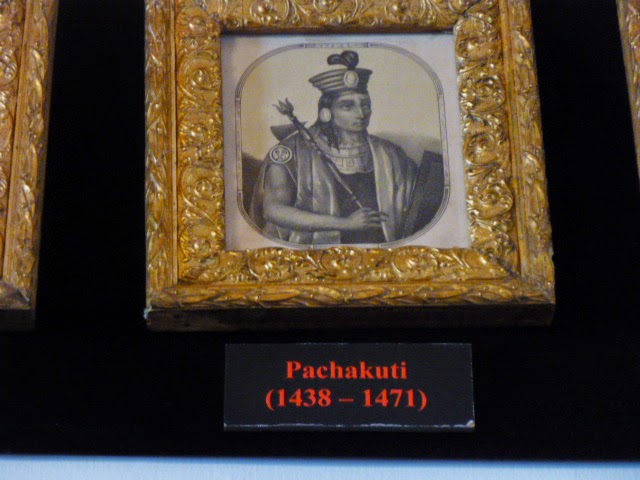
And these are the three Inca emperors . . .


And finally, here is a picture of Bolivia's first president, General Antonio José de Sucre Alcalá (for whom, obviamente, the city of Sucre was named.) He was the most famous and successful of the Bolivian generals during the war for independence.


So . . . as a person who enjoys history, I found the tour fascinating and very enjoyable. I wish I had taken more notes, but that probably would have been more than you really wanted to know, right?
That's all for today. Have a happy, healthy, safe week . . . y vayan con Dios.
Today will be a short blog because I'm sharing only the pictures from the Casa de Libertad in Sucre. The other places we visited (at least the ones where I was allowed to take pictures) were all religious sites, so I thought I'd group them together next week. I WISH I could remember everything the guide told us about the Casa de Libertad (House of Freedom) but unfortunately I can't.
The first thing she said, and this I won't forget, was: "This is Bolivia's equivalent of your Independence Hall in Philadelphia." Just thinking about it from that point of view made the visit more memorable for me. Here are some pictures and what I can best remember about it.
This is what it looks like from the outside, and of course it is built in the Spanish style - a big square around a central courtyard.
This is a closeup of the "throne" - or at least the chair in which the president sat.
And another closeup of the ornate carving and trim around the sides of the room.
In the next room there was quite a lot of material about their War of Independence. It went on forever. Actually it was a combined resistance from the countries of Argentina, Bolivia, Peru, Ecuador, and Colombia against Spain, because all those countries were included in the "Viceroyalty of Peru". The flag flown by the rebels was blue and white like this. (The original flag was under glass and looked as old and fragile as the shroud of Turin.) Bolivia became an independent nation in 1825 and kept the blue and white flag until about 1850, when it was changed to its present colors (red, yellow, green). The official Argentine flag is still this blue and white design, as you can see on the first picture below this.
This next picture is just for our friend Shawn (Kirchner).
The guide told us that the first president of Argentina was Bolivian by birth,
a hero of the revolution, and his name was D. Nestor Carlos Kirchner.
This shows the Argentine flag as well as the Bolivian state seal on the right.
The plaque is modern; I'm not sure exactly why it was placed here so recently.
Bolivia and Argentina have been allies ever since the 1800s.
Also interesting: the first president of Bolivia (General Sucre) was born in Argentina!
This is a close-up of the woman above.
Her name was Juana Azurduy and she was a mestizo (mixed Indian and Spanish.)
She fought alongside her husband in the war and was so brave and effective as a leader,
that she was made a Colonel. She was the only high-ranking female in the army.
She lost her husband and 4 of her 5 sons in the war,
so you can see why she is considered such a heroine.
This is sort of a memorial to La Coronel.
Her ashes are in the little chest.
The sword is the one she used.
Unfortunately, I'm not sure what those things in the very front of the picture are. (sorry)
This is a display from the same room . . .
. . . as is this sculpture portraying some of the soldiers (including La Coronel).
Next we visited a lovely room with some beautiful antique furniture and pictures of some of the military/historical leaders of the early years of the republic.
This is a portable desk (the part that's reddish-brown) which was used by the generals and so forth.
This sign, which you can just barely see fastened to the table below the desk itself, says:
"Field desk, used by the officials and other persons during the struggle for independence."
And here's what it looks like from the side, opened up.
You can see that it would actually be pretty handy -
- a place inside for all your writing supplies, and small enough to transport easily.
And this is one view of the courtyard.
Next we went into a salon that had formal pictures of all the presidents (65 of them in 189 years of independence.) Unfortunately all the pictures were under glass and I couldn't get good photos because of the reflection. However, I loved these two examples of the way the haut ton dressed in those days.
This is a picture of the current president, Evo Morales.
He is an Aymara Indian and eschews the formal dress (and glittering decorations) of previous presidents. He prefers to be photographed wearing a simple business suit - or so we were told.
Lastly we went into a salon that I suppose was used for social gatherings.
There were various miscellaneous "mementos", such as this hand-carved box with many drawers.
This sign explains that it was designed as an example of the Florentine School (of ??).
It IS beautiful.
This is what it looks like from the back.
All that wood is inlaid.
This is, I think, a harpsichord - and a very tiny one at that.
Farron had me stand by it so you could see how tiny it is.
I'm not sure why these pictures were in this room, but . . . anyway,
the plaque says: "The three Incas who pushed the expansion of their empire to the Charqueño Territory in the 16th century."
And these are the three Inca emperors . . .
Also in this room was this authentic coat of chain mail, which dates back to the 15th century also.
The explanation below says:
"This coat of mail was used by the Spanish conquistadors who came to this region in the 16th century The coat of mail was made of metal rings 8 millimeters in diameter, and weight 8.5 kilos (or about 17 pounds). When it was not being worn, it could rolled up and kept in a bag and thus transported more comfortably."
We think this was a separate piece that perhaps protected the thumb, hand and wrist.
That's all for today. Have a happy, healthy, safe week . . . y vayan con Dios.
Monday, September 1, 2014
We had a wonderful
experience yesterday afternoon. We were
invited as a temple presidency to attend the Cobija Stake Dance
Festival. (All it means to be invited as
the presidency is that we had to dress up in our Sunday clothes while everyone
one else was in their comfortable casual clothes – but it did also mean that we
got front row seats on padded folding chairs instead of having to sit on the
metal bleachers – hurrah!)
Well, we’ve seen
three different dance “shows” since we’ve been here – and all 3 were
professional – one in Sucre, one in La Paz, and one in Puno, Peru - each at a
sort of “dinner theater”. Like the folk
dances of most countries, I expect, the folk dances in Bolivia are very similar
one to another – the only thing that seems to change is the costume. The music sounds like the same song over and
over and the dances themselves seem to be the same 2 or 3, repeated in
different sequences. Plus they tend to
go on forever if all the different native tribes are represented. So we weren’t totally looking forward to
this, but I thought, “Oh well – if nothing else, it will give me some pictures
for the blog on Monday.” So off we went.
The program was held at a local high school ("colegio" in Latin countries is a high school, not a college.)

Well . . . we were very
pleasantly surprised. Instead of
representing different Indian tribes (or parts of the country), each of the 7
wards represented a different country.
We saw dances from Colombia, Russia(!), Puerto Rico, Spain, Venezuela,
Bolivia, Italy and the United States.
Anyway – that was
part of the pleasure. It wasn’t the same
dance over and over. There were some
similarities between the Latin American countries, of course, but not overly
so. Here are some pictures . . .


The second ward - Barrio Chimba - represented Russia.


Third was Barrio Cobija, who presented dances from Puerto Rico.


This is one of our security guards at the temple; he is also the bishop of this ward. It was so much fun to see him "in action".


Fourth, from Barrio Sarco, dances from the United States and from Spain (the flamenco).


One of my two favorites was the presentation of the “American” dance. They chose movements similar to a square dance mixed with a little bit of line dance, but before that, they had several men pretending to play the various instruments used in a hoe-down – i.e., fiddles, guitars, a harmonica, a drum and I forget what else – and they carried an American flag around while they “played”. The music was recorded and it was a VERY lively rendition of “Cotton-Eyed Joe”, which the dancers then used for their presentation. It was FANTASTIC and very, very well-done. Of course all us North Americans were delighted and showed it – which added to their and our enjoyment.
 |
| This is Brother Chambi, the head of the cleaning department at the temple. |


The fifth ward was Barrio Rosedal, in which our good friends the Mogrevejos were the stars (in our opinion) of the Venezuelan dance.


The Mogrovejos were members of an international folk dance
group when they were first married (in fact, that’s where they met) and they
were simply a JOY to watch. Such beauty
and grace!


Sixth was Barrio America, and they gave us 3 of the native Bolivian dances - the Cambinga, the Cueca and the Tinku (from an area where the natives speak Quechua).


These are two of our oldest obreras dancing in the Cueca. They are both in their late 70s or maybe early 80s - Hermana Hinojosa with the (fake) cholita braids and Hermana Perez in blue.


The Tinku dance is VERY much from an indigeno culture. Notice the amazing costumes.

This very Anglo-looking man IS an Anglo. He served his mission here, came back, married, has a construction business now and is a member of the High Council in the Cobija Stake.


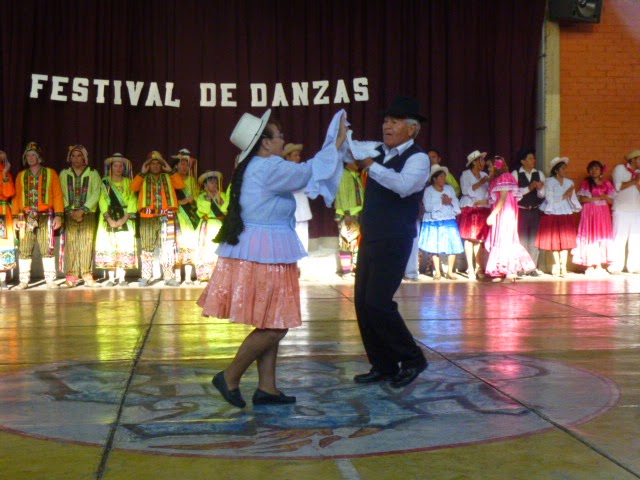
The last Bolivian dance from this ward was really sweet. This is a traditional "couples" dance, and the couple in this case are at least 70 years old. They were beautiful to watch.




And the last ward, Barrio Ingavi, gave a TERRIFIC presentation from Italy (in which the intro was as good as the dance.) Prior to each ward’s presentation, one person went to the microphone and gave a little information about the country they were representing – a little history, geography, interesting facts, etc. Well, we were waiting for the “introduction” to Italy, and in swaggered this short stocky man in a dark suit, super-dark sunglasses and a fedora – the minute you saw him, you thought “MAFIA!” And that’s exactly what he portrayed. To top it off, after we got a good look at him and before he said a word, the DJ played the theme song from “The Godfather”. I don’t know if everyone there got the joke but I assure you all the North Americans did.

Anyway, he did a little take-off on Marlon Brando – to be honest, I was laughing too hard to listen as carefully as I should have, so I didn’t quite get the connection – but in a minute or two, some men wheeled out a cart with a (fake) pizza about 4 feet across!


Then two cute little girls in the costume they were subsequently to dance in came to where we were sitting and served each of us “important people” (hah!) a slice of real pizza.

THEN, the dancers came on and did the tarantella while the “godfather” looked on benignly and clapped. It was WONDERFUL! The perfect ending to a most enjoyable show.


The VERY best part of the whole thing was
seeing among the dancers so many people we know from the temple. All in all, I (at least) came home quite
“high” from the experience – the way I feel after a wonderful concert. I’m still feeling it today. Much of it, I know, comes from the genuine
love that I feel for these people. They
are SO wonderful. We really are
brothers and sisters under the skin. It
has nothing to do with color, origin, ethnicity, or any other physical
attribute. We are children of a Heavenly
Father who loves us, and we should love one another as He loves us. Living here and working with these remarkable
people, it is very easy to love them (even when they’re late for
everything. <smile>)
Okay, that's it for today. Have a happy, healthy, safe week . . . y vayan con Dios!
Subscribe to:
Posts (Atom)