Monday, August 25, 2014

Hello, All --

Last week we spent 3 days in Sucre, the capital city of Bolivia.  It is not the largest city in the county by far (only 300,000 residents) and everyone talks about La Paz as the "real" capital, so I did a little research as to what's what (courtesy of BoliviaBella.com).  If you're not interested in history, just skip the next few paragraphs.  I find it fascinating.

When the Spanish colonized the Americas, they divided the continent into viceroyalties – large territories, each governed by a viceroy. Bolivia was initially a part of what was known as the Viceroyalty of Alto Peru which included what are now Peru, Bolivia, and parts of Chile. In 1825, when Bolivia gained its independence, it was founded as a Republic in the city of Sucre which was established as Bolivia’s capital city.  During this time, silver and tin mining were the country’s largest industries. Tin and silver were being mined in Potosí, west of Sucre and a great number of silver mine owners lived in Sucre (hence the huge colonial-style homes.)

Bolivia experienced a lot of upheaval during its first decades as a sovereign nation. (Just as a clue:  there have been 65 presidents since 1825!) In 1899 Bolivia’s Liberal Party and Conservative Party clashed in a struggle for political power. Sucre’s silver owners and large landowners supported the conservatives. Tin mine owners (many of whom lived in La Paz) threw their support behind the Liberal Party. The Liberals overthrew the Conservatives and immediately bid to move the country’s seat of government to La Paz.
In the end, an agreement was reached. La Paz became the seat of the executive and legislative branches of the Bolivian government and the judicial branch remained in Sucre. Today Sucre remains as the one and only capital of Bolivia, per the Bolivian constitution. However, La Paz is sometimes erroneously called the administrative (or de facto) capital.

In September of 2008 thousands of Sucrenses participated in protests and manifestations, wanting to move all branches of the government back to Sucre. The government accused them of promoting division and separatism in the country. Sucrenses were called enemies of the state.

President Evo Morales (the current anti-American president - an Aymara Indian - who will undoubtedly be re-elected this fall) and his political party the M.A.S. (Movimiento al Socialismo - Movement Toward Socialism) swiftly drafted a new Bolivian constitution amid much protest and violence throughout most of 2008.  Interestingly, the New Bolivian Constitution proposed by President Morales was approved by a narrow margin of just over 50%. Sucre remains the capital of Bolivia and La Paz the seat of government. The new constitution was approved by only 4 of Bolivia's 9 states (all 4 in Western Bolivia) and was not approved by 5 states (in the Eastern half of the country). Even though more states voted against it, the new constitution passed because the states that voted to approve it are more populated and have more voters.

And just as an interesting side note:  Sucre is supposed to get a new international airport, but because Morales knows the Sucrenses are opposed to him, he tries as much as he can to withhold the funds they need to build said airport.  Consequently it has been under construction for at least 2 years and will be for several years more.

Anyway, Sucre is our favorite city in Bolivia.  It is far cleaner than any other city; the historic downtown buildings are all painted white so it glistens in the sunshine; and the feeling in the city is just "nicer" than anywhere else we've been.

The most significant part of our visit this time was a tour of Sombreros de Sucre - a hat factory, so the rest of today's post will be about that.  Here we go . . .

This is our group at the airport on Tuesday, August 19th.   L/R, Harriet and Helen (sorry I don't know their last names!  They are Lynda Westover's 91-year-old aunt and 87-year-old friend who are here visiting from the U.S. for 2 weeks). Then the Westovers, the Runquists, and us.

The outside of the hat factory.

As we walked in, we passed bundles of wool like this . . .

. . . and like this.

This is a display in the registration room.


 Now we're down in the factory.
This is the first washing vat (the wool is on the bottom, under the water.)
The vat is filled with a mixture of HOT water and some sulphuric acid, to remove the natural grease.
It smells nasty, by the way.

This is the second washing vat - more of the same.

Here is the first-stage of the drying process.


And the second stage.  Notice everything is stirred and moved by hand.

Here's what it looks like after being washing and rinsed.

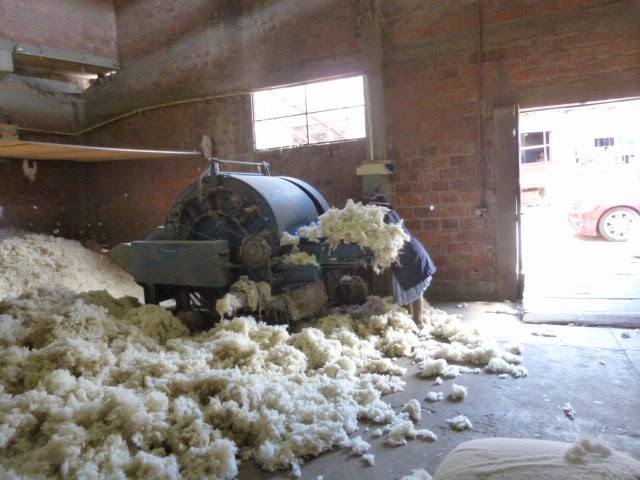
Next it goes into this big machine I call a "shredder".  
There are sharp metal teeth - or combs - that pull it apart.

From there it goes to this machine (the next 3 pictures) where Bolivian wool and Argentine wool are fed into the machine together and blown out the other end as a mixture of the two.  This apparently makes for a stronger, more durable fabric.  (Notice the open gears and total absence of any kind of safety gear other than the mask she is wearing.)


The combined wool then goes on this machine that turns it from clumps into a sheet of fabric.
(Next 2 pictures)


It comes off the above machine in a wide swath, and then is transferred to this narrower machine.
I don't know if they double it over, or what.
It comes off this machine in a steady "stream" of cloth.
The worker shapes it around what they call a "bell".
I took several pictures hoping you could see what she is doing.
It's a continuous motion, so to speak.


When it's just the right thickness, she cuts it in half.
This creates the size and shape they need to work with.
These are stacks of the wool/fabric cut off the "bell".

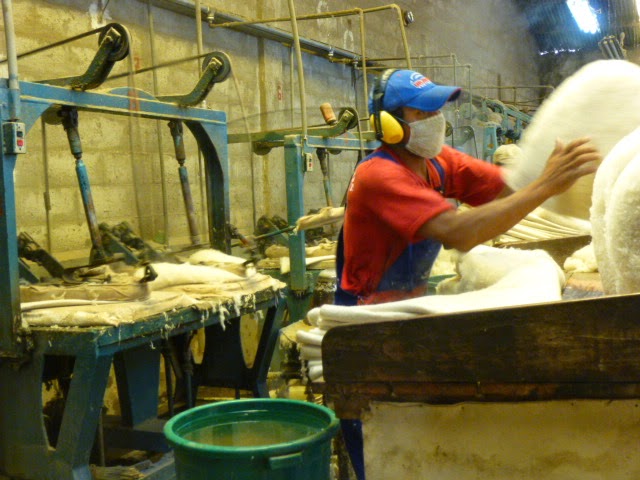
 Next the pieces are pressed under steaming hot irons (behind him).  
Notice one man is wearing a protective mask but the other is not.
I guess it's an individual choice.
We could see no evidence of any kind of safety requirements for anyone.

These two workers trim off the uneven edges so all the pieces are uniform.

Here's what the pieces look like after they are pressed and trimmed.

I honestly have no idea what is the purpose of this step.
The cut and trimmed pieces are wrapped inside a big wet piece of leather and run through this press.
They come out wetter and flatter, that's all I can figure out.


 Somehow I totally missed photographing the coloring process.
Here's one shot our friend Don Runquist took.
The machine on the left is dying white; in the center, brown.  
Behind these two machines there are more - lots of different colors.

Here are two pictures of the shaping process.  This man works hard and fast.


Then the hats are "buffed" on grinding wheels.
This struck me as a "sweatshop" kind of environment.
The workers are packed in so tight they are elbow to elbow.
However, the windows are open and there is at least light.
You'll notice most of them wear protective masks so they don't breathe in quite so much lint.


The next step is to iron and shape the brim of the hat.
That's what this man is doing.  (There were 2 of them working at this task.)

And here's a table of hats waiting to be taken to the trimming floor.

This is looking down the length of the trimming floor.
It's up one level; cleaner and better air, not much light though.


And finally, you end up in the sales room with a lot of beautiful hats just waiting to be tried on.
They have everything from Boy Scout/Mountie hats to very-stylish dressy hats for ladies,
and they come in every color of the rainbow.

 The average price on these hats is $10 (American) - a real steal.

  Elder Runquist in the gaucho hat he bought.

Sister Runquist with her cholita hat.
It's not too small for her; they really DO sit on top of the head like that.

Sister Westover with her cholita hat.

And Farron with his cowboy hat, in which I think he looks TERRIFIC!
I took this back at the hotel because the one I took at the factory didn't turn out well.

Okay, that's it for today.  Next week some other interesting stuff from our visit to Sucre.  Have a safe, happy, healthy week . . . y vayan con Dios!


Monday, August 11, 2014

Hello, All -- sorry to have missed a couple of weeks.  As you know, there were extenuating circumstances but I think we're mostly back to normal now.  Here are some photos from the end of July and the first week of August.

This was taken at Friday's (the Bolivian version of TGI Friday in the U.S.) on July 21.  We four couples are the only Norteamericanos here right now.  L/R - Elder Don and Sister Karren Runquist (Lethbridge, Canada), Farron and me, Sister Lynda and Elder Glen Westover (Coeur d'Alene, Idaho) and Sister Lona and President Jay Jensen (temple president and matron, from American Fork, Utah.)


After dinner (and by the way, this place has about the best food in Cochabamba, in my opinion), 
we decided each couple would share a dessert.
President picked this one because he thought it would be small.
Surprise!!

The very next day, we were walking one block from the temple down a main street and we saw this.
What she was doing with cows this far into the city, we have no idea.


 On Sunday, July 27, we visited the Cosmos Ward (Barrio Cosmos) in the southern part of the city.
We are assigned to visit all the wards in the Jaihuayco Stake during July-August-September.
There are two wards in each building, but we only had time to stay for one on the 27th.
We're going back to visit the other, next Sunday.


The next day as we walked home from the grocery store, I decided to get a picture of this tree.
It's not the African tulip tree I posted before - same shade of orange but different leaves, different flowers.
Because it's orange, I love it!


This is the best closeup I could get of the flowers.
Unusual, aren't they?


Happened to get a shot of a hummingbird - much bigger than the hummingbirds we have at home.
Excuse all the powerlines, please.  This does give you another look at the shape of the flowers.


Now we're into August.  Saturday, August 2, was Lynda Westover's birthday, so in lieu of a cake (since all cakes fall at this altitude), I made her a cheesecake.

This is how it looked with the candles lit. 
 

We four English-speaking couples celebrated her birthday after the evening shift at the temple.
  We enjoyed the dessert and sat and visited for well over an hour.  
Too often we don't take the time to do that. It was most pleasant.  
This is a photo of Lynda and Glen as the party broke up. 

On Monday, August 4, I finally got a picture of something I've been trying to get for months.
This is a tent set up in the median of a big, very busy street - Avenida Circunvalacion.
In fact, it is one of the two truck routes through the city, so there is a lot of traffic.
The woman who lives in the tent has been here for a long time.
Usually when we pass in the car, we're going too fast to get a picture.
I don't know where she gets her food or what she does all day (or what she does for a bathroom!)
She's always here whenever we pass by.
Can you imagine this happening on a major thoroughfare in any North American city?
Fortunately, the weather is mild enough in Cochabamba that with blankets she can be warm.
Hard to believe when we're at 9,000 feet, isn't it?


The 6th of August is Bolivia's "4th of July" - or "Dia de Pais" (Day of our Country".)
Because it is a national holiday, the temple was closed.
Lynda suggested we should have the 4th of July barbecue we missed in July 
(because we were all working in the temple.)
Here we are in the kitchen of the president's house - the burgers are being grilled outside.
L/R:  Runquists, Westovers, Jensens, and Farron.

You can see we had an all-American spread:  potato salad, baked beans, deviled eggs, hamburgers with the works, and chocolate-chip cookies for dessert.  It was delicious.


Here's a photo taken in the president's patio.
It was a little too sunny, but most of us managed to stay partly in the shade.

We went in the house to visit for a while and let our lunch settle before eating dessert,
so we took a picture with the automatic setting on our camera.  
I think it was on a not-quite-level surface.  Agreed?  Still, it's a great picture.


Okay, that's it for today.  Have a safe, happy, healthy, productive week . . . y vayan con Dios!

Monday, July 21, 2014

Hello, All --

This has been an ordinary week at the temple for July, which means very busy.  Here is a picture taken with a couple of young adults from Santa Cruz.  They had been in the temple earlier in the day and were taking some pictures before getting on the bus for the all-night ride home.


One slightly-unusual occurrence this week was that we got caught in a real DOWNPOUR, which isn't supposed to happen this time of year.  Theoretically, it's not supposed to rain again until November.  The thing about rain here in Cochabamba is that - during the winter - it means snow on all the passes between here and all the other cities.  Here are a couple of pictures of the snow on the mountains between here and La Paz.  These were taken Sunday, two days after the rains, so some of the visible snow had melted.


Last night (Sunday, July 20) we had a little musical program here at the hospedaje.  This is the second year that BYU has sent 5 music students down to Cochabamba to teach at the Fundacion Sinfonica de Cochabamba for one month.  This year's students were not anywhere near as accomplished as last year's (to my personal disappointment), but they are very nice girls and shared their talents with an evening of hymn arrangements instead of the more difficult classical music we heard last year.  Only one of the group spoke Spanish this year; hence they sang several hymns in English.  Here are some pictures.

They sang I Am a Child of God (in English) and Rachel Cottam (from Provo, Utah) played the churango, a native Bolivian instrument that to me sounds somewhat like a mandolin.

This is a closer picture of the churango.  It has 8 strings.
Rachel only bought it 2 weeks ago, so I was impressed that she could accompany the girls with it.

The violinist is Jenny Jones from Springville, Utah; the flautist is Kristen Blackham, 
from somewhere in New York.  They did a medley of For the Beauty of the Earth
and All Creatures of Our God and King.

They sang (in Spanish) Abide With Me, 'Tis Eventide.
They had 3-part harmony, very nice - a capella, too.
The girl in the very center, Kate Jessop (also from Utah),
plays the contra bass (the BIGGEST string instrument in the orchestra),
so she didn't have her instrument with her.
She has a lovely singing voice though and we benefited from that.

This is Rachel Cottam again; she plays the oboe beautifully.

A little later in the program, they sang A Child's First Prayer, 
which is Sister Jensen's favorite Primary song.

This was a flute, oboe and piano trio on Lead, Kindly Light.
The pianist is Rebecca Cottam; she and Rachel are twins.
Rebecca also plays the bassoon, but didn't bring it with her last night.

And finally, for their finale, they sang Be Still My Soul.
This is not in the Spanish hymnbook, so they had to sing it in English.
Rachel (on the right end) sang tenor, so they had 3-part harmony.  
It was a beautiful ending to the program. 

Okay, that's all for today.  Have a safe, happy, healthy week . . . y vayan con Dios.

Monday, July 14, 2014

Hello, again --

No trips or "big things" to tell you about this week, but here are some miscellaneous information and pictures that I hope you will find interesting.

First, these men were pushing these HEAVY loads on wheel-barrow-type carts on one of the main downtown streets.  We were behind them in a bus.  I can't imagine people pushing carts loaded with cement mix down a street in the middle of traffic at home, can you?


Second, we saw this on the way home from church yesterday.
This is a major street paralleling the river.
If you open this picture to full size, you will see a man washing his clothes in the dirty river -
quite a common sight actually.  Sorry the picture isn't bigger, but I was in a taxi when I took it.


A couple of weeks ago we had a Santa Cruz stake bring their entire Youth Conference here for one day.
There were about 120 kids (12-17) and about 25 youth leaders.  
They came all the way from Santa Cruz (an 8-to-10 hour trip) 
in what looked to me like glorified school buses.  Such dedication and testimony! 

They came in the morning and went home that evening.
Can you imagine 8-10 hours in a bus like this?  Ugh.

Then just this past Saturday another big group of youth came,
this time from the city of Oruro (only 4-1/2 hours away.)
They were in buses like this - more the size of a Greyhound - 
but since I don't like buses of any kind, 
I still find it very admirable that they make such long trips.


Yesterday we visited a different ward from the one we usually attend.
This is the Barrio Lindo building.  It sits down below street level, so it was hard to spot,
especially since the tree in front covers the nameplate.


Now a total change of pace - some pictures of different plants.
First, this plant in our apartment.
In my whole life, this is the only live plant I have managed not to kill.
I am so proud of it.

In fact, as you can see,
it has a brand-new shoot right in the center.
Whoopee!

This is one of the "bird of paradise" plants alongside the steps from the hospedaje up to the temple.
I have never seen a white one before.
Do you think maybe it was the color they normally are,
and then the cold temperatures at night froze it?


And third, a native vine that I really want to plant along our fence at home.
Of course you know I LOVE orange, 
and the flowers cascading down the wall are so beautiful to me.

Here's a closer view.

And here's the closest view of all.  Aren't they gorgeous? 


Lastly, here's something really special to me.
This ring is made of Bolivianite, a stone that is ONLY found here in Bolivia.
Below the picture I will post the legend of Bolivianite.


Legend of Bolivianite (Ametrine from the Mine of Anahí)

What is not a myth: Bolivianite is a beautiful purple and honey-colored precious gem formed under almost impossible conditions. It is a unique blend of purple amethyst and yellow citrine which scientists are now calling ametrine. It is produced under such exceptional and improbable conditions, requiring a perfect combination of iron presence and differing temperatures within a very confined area, that it has occurred only once that we know of, in only one known place in the world: Santa Cruz, Bolivia. The Anahí mine is the one and only bolivianite mine known to exist anywhere on Earth.

Legend has it that along with an expedition of Spaniards exploring what is now Eastern Bolivia, came a soldier called Felipe de Urriola y Goitia, who made contact with the peaceful Ayoreo tribe. The daughter of the Ayoreo chieftain, Princess Anahi, fell in love with Don Felipe and asked her father’s permission to marry him. The chieftain agreed and as a dowry, he gave her husband a mine that produced a beautiful two-colored gems, to which the conquistador didn’t pay attention, deeming it not as worthy as gold, silver or emeralds.

When Don Felipe thought it time to go back to Spain, Anahi was torn between her loyalty to her tribe and her love for Don Felipe, but was prepared to follow him anyway. Enraged by what they saw as abandonment, and jealous of Don Felipe, her tribesmen conspired to murder him to prevent him from leaving. However, Princess Anahí warned him and he and his men were forced to flee.

Sadly, during the confrontation, Anahí was injured by her own tribesmen. Dying of her wounds, Anahi asked to see her husband one last time, and placed in his hands a beautiful stone from the mine her father had given them as a wedding gift. She told him it was a token of her eternal love. Anahí died in her husband's arms. When he opened his hands and saw the gem, he knew that the stone's two-colored blend of perfectly blended deep purple and honey symbolize Anahi's heart torn between her love for her husband and her love for her people.

That gem is what is now called Bolivianite, and the mine that produces it is named the Anahi Mine, after the Ayoreo princess. It is located 150 kilometers North of Puerto Suárez, a town in the Eastern tropics of Bolivia, very near the border of Brazil. The mine site covers an area of about 6250 acres.


Isn't that interesting?  I am thrilled to have a life-long reminder of our time here, and as Sister Jensen so wisely commented, "Better yet, it doesn't have to be dusted!"

Okay, that's all for today.  Have a happy, healthy, safe week . . . y vayan con Dios.