Monday, April 1, 2013

A week ago today - March 25th - all the North American temple missionaries as well as three of the Latin couples took an all-day bus trip and visited two places.

First we went to the Parque Ecoturismo Pairumani - which is just what it sounds like:  a big park where the government has preserved the natural environment.  Unfortunately I had forgotten to charge my camera the night before and was afraid of the battery dying before we got to our second (and more glamorous) stop, so I took only a couple of pictures at the park.  Here they are:

You probably can't read it, but the words on the effigy say "Thieves will be hanged." I don't know if they mean it or not, but I should think it's a pretty effective deterrent - wouldn't you?


Notice the wildflowers beneath these signs.  There's water in this park - you can sort of see the stream in the picture below.  It is a good healthy stream and it is falling at a tremendous rate.  In fact, it was used to provide hydroelectric power for the super-rich industrialist whose country home we went to visit after our picnic here.

 
That building you can see in the above picture was part of the electrical generating plant.  We walked past it (and past the bull you see tethered there -- we don't know how he got there, since this is government land and he's obviously private property -- but oh well) - to some nice picnic tables (with nearby rest rooms.)  There was a hike (about a mile, I think, and at this altitude it was WORK) up to a little grassy plateau from which we could see forever - and also see the dam and resultant waterfall that were built to fuel the hydroelectric plant.  Although it took us an hour to get here, we weren't that far out of Cochabamba.  We could see the whole city from this mountain.
 
After our hike and picnic, we drove about 20 minutes back down the mountain and toured the country home of a man I'd never heard of, but his story is so interesting I'm going to add it here . . . a mini history lesson, but I think you'll like it.

His name was Simon Iturri Patiño.  He was born 1 June 1862, died 20 April 1947 in Argentina and was buried in Cochabamba.  I'll skip his early life.  The important thing is that as a young adult, he
started in mining with Compañía Hunanchaca de Bolivia, a silver company, and then with Fricke y Compañía. Patiño was assigned to collections for the store, and in 1894, he agreed to accept a deed of land in compromise for a $250 debt owed by a prospector. The deed turned out to be for the rocky side of a mountain, and Patiño was fired from his job for settling an account in exchange for a worthless piece of property. Legend has it that Patiño was forced to pay back the store from his own funds, and was stuck with his own bad bargain.

The mountain turned out to be richer in minerals than anyone had imagined. Although the first several years of work yielded little, the turning point came in 1900 when Patiño located a very rich vein of tin, later called "La Salvadora" (The Savior). Over the next 10 years he built up the control of nearby mines and other important mines in Bolivia.  By the 1920s he had also bought out Chilean interests in his mining company and went on to buy tin smelters in England and Germany. By the 1940s he controlled the international tin market and was one of the wealthiest men in the world, hence his "title" The Tin King (Rey del Estaño).  During WWII he was considered to be one of the five wealthiest men in the world.  How about that?!?  And I'll bet you had never heard of him either.

What is really sad is that because of his health (he had a heart condition that could not survive the altitude in Bolivia), he had to live abroad for the latter half of his life.  He never set foot in this beautiful home he built in the country for his wife and children and I believe the same is true of the even more grandiose home he caused to be built within the city of Cochabamba.  Apparently his family spent at least half the year in Bolivia, even though he had to stay in another country.  His descendants (great-grand-children) still come to the country home in the summers.  They live in the second story; the first story is a museum.   His city home has been given to the government and is a museum we have yet to visit.

Here are the pictures of his country home - which interestingly enough is called the "Villa Albina" (named for his wife.)  It is open 1 hour each day (from 3-4 pm) Monday through Friday.   This is what you see as you walk down the long driveway. The grounds are extensive and utterly beautiful, too.

 
This is a little closer view so you can maybe read the title near the top in the center: Villa Albina.


The statue (Venus, or ???) stands in the center of a lovely circular garden, facing the house.

This is what you see when the front door is opened and you step inside. The house is built around an open courtyard - typical Spanish architecture.

Here's a picture of the two of us sitting at the fountain (our backs are toward the front door.)  I tried to post this in Facebook instead - sort of as a trailer to bring friends to look at the rest of these pictures - but couldn't get FB to cooperate, so . . . it's here instead.


The view of the house taken from in back. There also is a long one-story wing off to the right, behind
that enormous tree.


Now pictures of the interior . . .  the first is a room that was originally a music room - for family concerts and/or for visiting musicians to perform.  Now the Patiño Foundation uses it for board meetings, if we understood the guide correctly.  (To me it looks like an old-fashioned church sanctuary - what do you think?)

This room was NOT used for music, nor was it the dining room.  We are not sure exactly WHAT it was, but it's pretty.

This was the "ladies' sitting room" - not really a boudoir or powder room - but still a place they gathered to primp a little, I guess.

This may have been meant for an office - or perhaps just a formal sitting room.  The most important thing about it, to me, is that a portrait of Señor and Señora Patiño hang here.

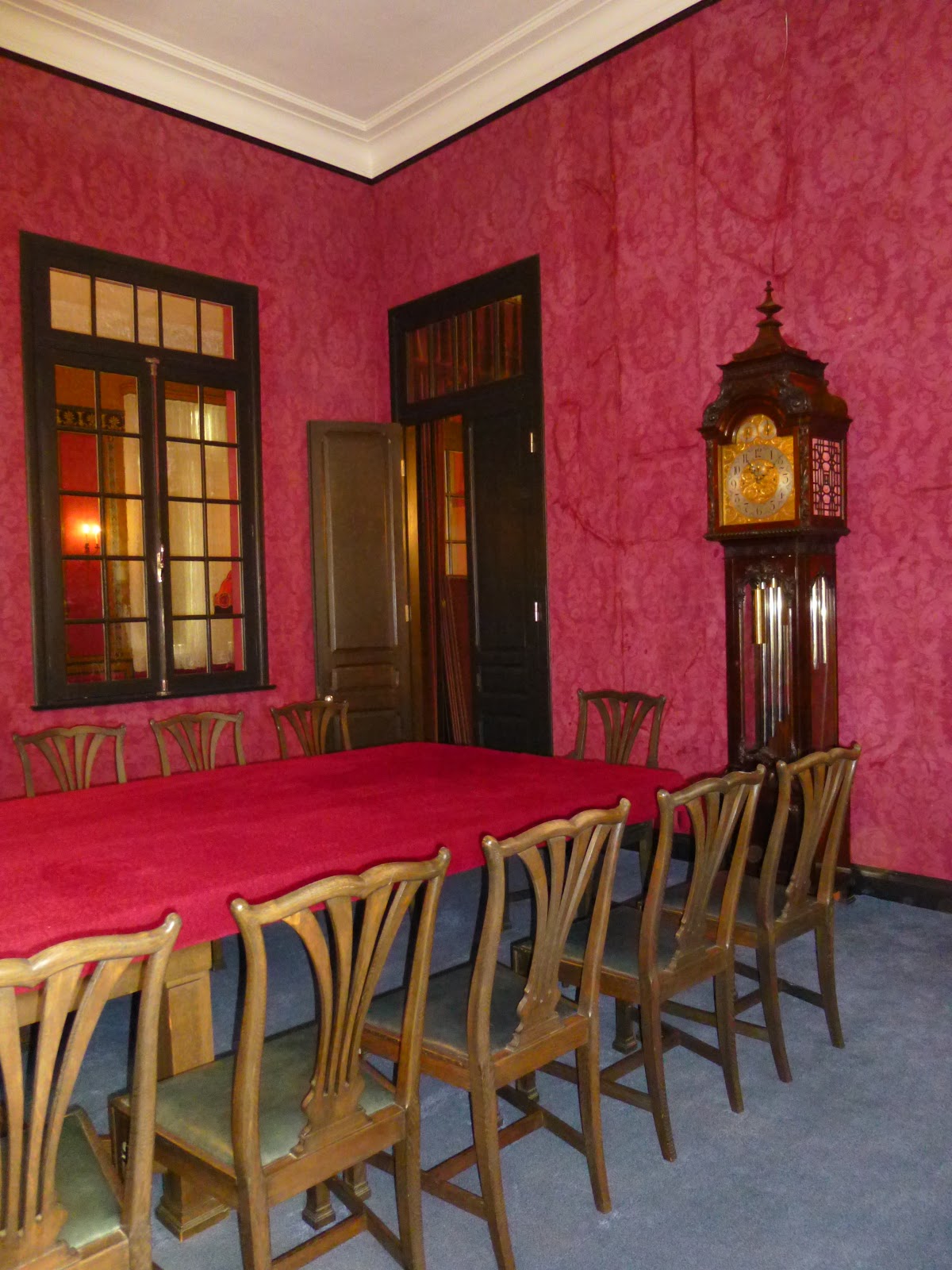
This is just one end of the dining room (I wanted you to see the grandfather clock.)  This table seats 24 and is fully extended all the time.  The room is quite elegant, but I don't know if I could enjoy a meal in a "fuschia" room.
This was their ballroom.  Of course now you see tables and chairs in little groups, but I guess the tables were removed and the chairs placed around the perimeter so they could have room for dancing.

This was another small sitting room - not sure why they needed so many.  Notice how HIGH the ceilings are - much more than the 9' ceilings in our La Verne home - these must be 12' or 15' high.

This was a tea room - as in "4:00 afternoon tea" like they have in Great Britain.  The room is twice this long with several more sets of tables and chairs.

I should have put this at the beginning with the exterior shots, sorry.  They actually had a swimming pool.  The gardener was mowing the grass around it while we were there.  It must keep a full staff of gardeners busy taking care of this place because the gardens and grounds are enormous.  There is also a fish pond big enough to use a small rowboat in.  There's an archway-walk with a gazebo built out into the water, and the gazebo has a little boat dock.
 
 
And finally, one shot of a small part of the grounds, taken as we were walking back up the driveway.  
 
We really enjoyed seeing this BEAUTIFUL home.  Several of us remarked that we could just imagine ourselves living here, dressed in long dresses with hoop skirts (sort of like those Southern mansions you read about) - but only if there were a multitude of servants to keep the place clean and do all the laundry, ironing, cooking and so on.  In other words, living like a multi-billionaire, which Señor Patino was.  How sad that he never got to see this place or live here.  What good is all the money in the world if you can never go home to the place you love?  I'll bet he would willingly have traded a chunk of his money for a new heart.  Too bad heart transplants hadn't been figured out yet.

Sunday, March 24, 2013

Well, we made it through our first week in Bolivia.  It was stressful, but I hasten to admit that all the stress was self-imposed.  However, I have faith that things will get better - and I'll get better at finding my way around this BIG beautiful temple, better at fulfilling my various responsibilities, and better at speaking Spanish.  So in the meantime, here are a few more notes and pictures . . . . (remember you can double-click on the pictures and they will come up full-screen size.)

First, I wanted to give you a little better idea how BIG the temple grounds are.  Six acres is hard to visualize, but here's a picture taken from across the street that may help.  The white building on the left (with the pink roof) is the Temple President's home.  In the center is the BIG hospedaje where we live - in fact, it's the biggest thing in the picture.  And on the right about halfway down the picture, you can see the temple spire. 


Now here's a picture of the hospedaje itself, so you can see how big it really is.  Our apartment is on the top floor and faces the temple.

Here are a couple of pictures of our apartment.  It's very cool, clean and convenient.  There is NO heating or air conditioning built in - it all works on a "natural climate" system.  When it's hot, you open all the windows and turn on a fan.  When it's cold, we will close all the windows and (probably) move the little space heater they've given us from room to room as we need it.  <smile>  It doesn't get colder than 60 degrees (we hope), but that can be pretty chilly, as we learned in Ecuador.  We have lots of blankets and I brought sweaters, so hopefully we're prepared. 

This is our dining area and the front door on the right.  I am standing with my back to the kitchen.
 
Next, here's the living room.  I am standing with my back to our windows, facing the front door.  There's a couch to my right that matches the two chairs.  A big flat-screen T-V is out of sight to my left.  We haven't turned it on yet <smile> though I hear there's a possibility of getting the "March Madness" games and if so, I think our abstinence from T-V will cease.

A look at our bedroom - I am standing in the doorway with my back to the living room.


And the kitchen . . . small but efficient.  Note the "American" stove - flat electric burners, and an oven with a thermostat.  You can't get much better than that.


There are some things about this mission that are really different from Ecuador – and I think this is the reason we are struggling a little to get acclimatized.  First, there is the location. It is SO high here (almost 9,000 feet) that we are gasping for breath when we climb the stairs to the temple.  We’re thirsty all the time (and yes, we’re drinking water constantly to hydrate), plus we’re tired.  I haven’t had this little energy in a long time and I can only ascribe it to the altitude, which means we should get used to it eventually.   Second, in Ecuador we started right out working with the members, living in an apartment building, and because it was a smaller city and we were living near the city center, we could and did walk everywhere, thus getting our bearings and getting a feel for the place itself.  Here we are of necessity insulated from the city proper – plus the temple is in one of the nicer residential areas rather than near city center – and because we are so unsure of ourselves in so many aspects (learning our responsibilities, my weakness in Spanish, etc.), we aren’t pushing the ticket to get out and see what’s here and interact with the people so that we will begin to feel at home.  (Plus, anywhere we walk is going to be downhill, which means a tough uphill climb coming back, so we’re not making that effort yet.)  Third, in Ecuador we knew how to do what we were called to do – work with the members, help the branch and district leadership, help the missionaries teach occasionally.  Here, we are learning something totally new – like changing employment and learning a new job - and in a foreign country at that – and we all know how unsettling such things can be! 

So . . . as of yet, we really haven’t recovered our equilibrium physically or mentally, but it will come.  We know we are where the Lord wants us to be.  We know, and have a deep conviction of, the beauty and eternal significance of the temple ordinances.  The temple really IS the Lord’s house, so what better place to be?  I’ll just be a whole lot more relaxed and able to appreciate it after I have learned my way around AND learned all I need to know in order to function effectively and efficiently.
 
Lastly, to end on a positive note, here's a picture of us ready to go and serve in the House of the Lord.  I accidentally included both pictures and can't figure out how to remove one, so . . . sorry for the redundancy.


Until next week, vayan con Dios . . .
 

Monday, March 18, 2013

Okay, here we are.  We got up at 3:30 a.m. (at the MTC) on Friday, March 15th to get ready for an 8:15 flight out of Salt Lake City.  By the time we got to Cochabamba on Saturday, March 16th, we had been traveling about 39 hours and by the time we got to bed that night, we had been up 42 hours with hardly any sleep (maybe 2 hours on the night flight from Miami to La Paz.)  Thank goodness that trip is OVER and I don't have to think about it again for 18 months!

Here are a couple of shots from the plane on the last stage of our journey (from Santa Cruz, Bolivia - which is lower and - at this time of year - hotter than here - to Cochabamba).  You can see, I hope, how rugged the Andes are, and they are 12,000 feet and higher - but it's literally "high and dry".  This is the rainy season and look how brown the hills are.  The fourth picture is our best shot of the city as we came in for a landing.


We were thrilled to learn that Cochabamba has its own Christus like the one that is so famous in Rio de Janeiro.  We've been told this one is even bigger.  This is just a shot I took from the car as we were driving through Cochabamba to the temple.  Sorry it's so blurry.  One of our first P-day trips will be to taxi and/or climb up there and get some really good shots.

The airport is on the south side of Cochabamba; the temple is on the north, up in the foothills.  The area is called "Queru Queru Alto" (because there is a Queru Queru that is further down in the city.)  The temple grounds cover six acres.  We live in a 3-story (4, if you count the basement) building called in Spanish el hospedaje (literally, "the lodging".)  It is very large.  About 1/3 of the 2nd and 3rd floors are apartments for us temple missionaries.  The other 2/3 of all three floors are lodgings for the people who come here to the temple from all over Bolivia and parts of Peru, Argentina and Chile. I think someone here told me they can sleep 200+ people in those lodgings.  They also have BIG shower/bathrooms and a huge kitchen/dining room with two large cooking areas.  It is actually closer and cheaper for the people in southeastern Peru, northeastern Chile, and northwestern Argentina to travel here to this temple than to any temple in their own countries, although each country has at least one of its own and sometimes more. It appears Bolivia is the least expensive country in South America for travel costs, food, etc.

Anyway, we missionaries have our own big laundry room (on our floor) - 4 washers and 4 dryers - and each couple has a nice 1-bedroom apartment (8 to a floor).  Ours is on the north side of the building (#307) and we have a gorgeous view out our living room and bedroom windows because we are looking straight up the hill at the temple.  Here are some pictures I took Saturday afternoon and evening from our living room window.  Unfortunately, I can't open the windows wide enough to get any bigger shot.


The temple grounds are on a hill, as I think I said. This view above is from the third floor of the hospedaje and I think you can see that the temple is quite a bit higher than we are.  Can you see the flights of steps leading up to it?  When we leave the hospedaje to go up to the temple, we come out some beautiful big double doors on the basement level and there are 7 short flights of stairs to climb to the front door of the temple itself.  This afternoon I went down and took some pictures from that vantage point, which is more of a "straight-on" view.  The first one is from the basement level, right outside the double doors.  You can see how much higher the temple is - and I realize you can't see much of it - but I wanted to get the Bolivian flag flying by the hospedaje.


I went up the first two short flights of stairs and took the next two pictures.  The second one is to give you a wider-angle view of the temple grounds, which are absolutely beautiful.  Keeping up the grounds (with all the trees and flowers AND those in the median in the street beside the temple, which the Church also maintains) gives several church members full-time employment. In fact, it's probably one of the better jobs around here.


The only problem is that you can hardly see the Angel Moroni from this far away, but oh well . . . we can't have everything (at least not while I'm taking the pictures.) 

Now that we've had a couple nights' sleep, we are feeling slightly (but only slightly) less overwhelmed.  It simply takes time to get used to such big changes in one's life, and of course I want to be fully adjusted and competent immediately.  By the time I post next week, I hope my nerves (and my stomach) will have settled down and we'll both be almost back to normal.  In the meantime, this beautiful view does much to comfort and strengthen us.

Tuesday, March 12, 2013

Today was our second day of training at the Provo (Utah) Temple.  The focus (or motto, or mantra, or whatever) is "How can we make the temple experience as uplifting and beautiful for the patrons as possible?"    (Patrons are those persons who come to attend the meetings at the temple.)  In South America and other parts of the world where there are not as many temples as in the United States, coming to worship at the temple may mean an all-night bus ride and a significant sacrifice of work-time and income.  Our goal is to help the patrons feel that every ounce of sacrifice was worth it because their experience at the temple was so spiritual, uplifting and strengthening.

We have fourteen couples in our training group.  We all started at the Missionary Training Center on March 4th and had one week of proselyting training (even though it's highly unlikely any of us will be doing any proselyting.)  Today we gathered after our training session and snagged a friendly passer-by to take our picture.  Here it is:


Sorry I can't make it bigger, but hopefully if you click on it, you will be able to.  Front row, L/R:  Elder and Sister Dominguez, going to the Mexico City Temple; Elder and Sister Bassett (age 80!), going to the Tegucigalpa, Honduras Temple; Elder and Sister Wade, London England Temple; Farron and I; Elder and Sister Gray, Santo Domingo Dominican Republic Temple.  Second row, L/R:  Elder and Sister Day, going to the Tampico Mexico Temple; Elder and Sister Jackson, Palmyra New York Temple; Elder and Sister (Garth and Jean) Morgan (whom we knew for 18 years in the La Verne Stake), going to the Boston Massachusetts Temple; Elder and Sister Crowley, Apia Samoa Temple; Elder and Sister Yorgesen,  Johannesburg South Africa Temple; Elder and Sister McEwan, Washington D.C. Temple; and on the very back row, Elder and Sister Barrus, going to the Papeete Tahiti Temple.    The picture below is just so you can see the Provo Temple itself, behind us.


We are having a lovely time this week, spending most of each day in the House of the Lord.  It is a beautiful, peaceful, uplifting place to be.  We are going to LOVE our mission!!

Friday, March 8, 2013

Today is the last day of our first week of training.  Boy, are we tired!!  It's amazing how exhausting just sitting in classes, preparing for teaching experiences, and participating in those experiences can be.  I think we might not be so tired if we could have gotten outside for exercise, but it's been too cold to do any walking in the evenings after dinner.  Last night we went into the exercise room across the hall from our apartment and spent 15 minutes on the treadmills and 15 minutes on the stationery bikes.  (Compared to some of our super-fit children, that's a laughable amount of exercise, but hey!  It's better than nothing.)

We're supposed to get snow tonight, maybe.  It's very cold today but no precipitation of any kind.  Speaking of snow, here's a picture of the mountains last Saturday.  They really are beautiful, aren't they?  (Even so, I am praying for no more snow while we're here.)


Wednesday, March 6, 2013

This is a picture of our district at the MTC.  Front row, left to right:  Elder and Sister Meese (pronounced meesey) from Utah, going to Manchester England as MLS missionaries (Member and Leader Support) replacing David Hancock's parents who are on their way home;  Elder and Sister Wade, going to the London England Temple.  Back row, left to right:  Farron and me; Elder and Sister Chatfield from Boston, Massachusetts, going to Portland, Oregon as MLS missionaries.

Monday, March 4, 2013

At last we are here at the MTC (Missionary Training Center) in Provo, Utah.   We will be here eleven days.  There are 44 couples and 2 older sisters in our training group.  Interestingly, one of the couples - Elder and Sister Meese - are going to the Manchester England Mission, from which our son-in-law David Hancock's parents are returning later this month.  We are sending good wishes to the Hancocks but I'm afraid the Meeses may get there after the Hancocks have started home.


We had a delightful conversation with this missionary couple outside our room this evening.  Their name is Bassett and they are from Wyoming.  This is their fifth mission - and all have been outside the United States.  They served twice in Tegucigalpa, Honduras - then once in Mexico, once in Costa Rica - and now they are going back for a third time to Tegucigalpa.  It has been 27 years since their first mission and this time, one of the little girls they knew and taught back then will be the translator for whichever member of the Presidency of the Church goes to Tegucigalpa to dedicate the new temple there on March 17th.  This is like going home for them, because they know so many people and have developed such strong bonds of love over the years.  But here's the real eye opener:  they are 80 years old!  Isn't that amazing?  I am so impressed. They are really remarkable and admirable people and I am in awe of their dedication and selflessness.